Monday, 17 June 2013

Uckfield to Lewes

BACKGROUND

A statement from the Department for Transport on May 9 2013:

Secretary of State Patrick McLoughlin has asked Network Rail to examine if re-opening the Lewes - Uckfield railway line will meet the demand for the future growth in rail travel.
The Government’s Rail Investment Strategy already requires additional rail capacity to be delivered between Uckfield and London Bridge by 2019. This is likely to be achieved by adding more carriages to trains running on the route.

Now a new study commissioned by the Secretary of State is looking at rail provision between London and the south coast further into the future and as part of its terms of reference will re-examine the case for a new line linking the Sussex towns.

Patrick McLoughlin said:

“I am alive to local interest in re-opening this line and wider concerns about rail capacity between London and the south coast and this is why I have commissioned this study.

“It will help us to understand exactly what the issues are and build upon previous work that has looked at these questions.”

The Secretary of State will visit Lewes station on Thursday, May 9, where he will meet local MP and Transport Minister Norman Baker to discuss rail provision in the constituency.

The study will feed into decisions on the future funding of the railways. The current Rail Investment Strategy outlines funding priorities until 2019 and this work would inform any business case for changes to rail provision in the area beyond that date.

The line linking the two towns was closed in 1969 but there is local appetite to see it brought back into use.

Recent moves to devolve decision making for local transport schemes will also give greater freedom to local councils and enterprise partnerships to determine priorities and allocate funding accordingly.

Richard Eccles, Network Rail director of network strategy and planning, said:

“The railway between London and Brighton is one of the busiest routes in the country and there is very little space available to run additional trains. As the number of passengers continues to grow, it is right that we look at a wide variety of options which may help provide extra capacity in future, ensuring that the rail network can continue to support and drive economic growth in the region.

“We are already reviewing the options for capacity enhancements to Brighton and the south coast corridor and this work will feed into a Sussex route study due for development in 2014. Within this we will include a review of the value that a re-opened Lewes - Uckfield line could play in meeting future needs.”

As recently as 2008, a study into reopening the line between Lewes and Uckfield showed a benefit to cost ratio (BCR) of 0.79. The usual rule for projects in England is that they must have a BCR of 2.0 or above to stand a chance of any funding. The idea disappeared rapidly on to the back burner. However, this study's remit was merely into reopening the line, not the wider benefits.

SO WHAT ARE THE WIDER BENEFITS? AND THE CHALLENGES AROUND THESE?

Funny you asked that. Here's a map which shows what we are talking about:

(courtesy Network Rail, from the PDF above)

This is about considerably more than reopening eight miles of track. There are a lot of facts which need to be taken into consideration:

  • If you are going south from Uckfield, you are more likely to want to go towards Brighton than Eastbourne. Indeed, this changed the alignment north of Lewes in 1864 from one similar to the one shown above, to one approaching Lewes from the north to the east of the station. However, that route is overbuilt and within a conservation area, so is considered to be impractical.
  • Three peak trains per hour to London Bridge start from Tunbridge Wells. These could start from Lewes and beyond, and go via the 'Spa Valley Railway'.
  • East Croydon is a huge bottleneck, and more trains cannot go through there without major investment.
  • The Brighton Main Line is at capacity, with a two track section from south of Balcombe Tunnel Junction (south of Three Bridges station in Crawley) to Brighton. There is a need to create one or more diversionary routes, not only to expand capacity but to create contingency: the infrastructure is a little fragile. Quadrification of the dual track section is considered to be too expensive due to the number of tunnels and viaducts.
  • South of Hurst Green, the railway to Uckfield is not electrified. This leads the debate into a question of AC/DC . Or even AC/DC . In essence, the Southern Railway's model of an electrified third rail is susceptible to cold weather, and more expensive to run. Which model of electrification would you adopt, if any?
  • 'The Lavender Line', a piece of preserved railway, runs along a mile and a half of the proposed route.
  • The Wealden Line campaign group were instrumental in pushing the case for the Lewes-Uckfield reopening. Now they are opposed to pushing for that reopening, believing that it would be rejected for the same reasons as the original study in 2008; they promote a much bigger BML2 scheme, with the objective of creating a second Brighton to London main line.
  • A significant proportion of the traffic from Eastbourne and Lewes is heading for Haywards Heath and Gatwick Airport. It's therefore not practical to divert this traffic via Uckfield.
  • Leading on from the point above, traffic arriving and departing from Lewes is over and above the current traffic. The station is sufficiently busy that trains for Uckfield would have to depart from Brighton, Seaford, Newhaven or Eastbourne, or a purpose built siding close to Lewes.
  • Various parts of Hurst Green to Uckfield are single track.
  • Hurst Green to Uckfield is limited to 70mph.
LOOKING AT THESE POINTS IN TURN...

If you are going south from Uckfield, you are more likely to want to go towards Brighton than Eastbourne. Indeed, this changed the alignment north of Lewes in 1864 from one similar to the one shown above, to one approaching Lewes from the north to the east of the station. However, that route is overbuilt and within a conservation area, so is considered to be impractical.
 
BML2 have the idea of a tunnel to bypass Lewes. While this creates faster services from Brighton to Uckfield and beyond, there's one issue. It bypasses Lewes. Norman Baker, Lewes MP, Transport Minister and supporter of reopening Uckfield to Lewes doesn't like the idea of bypassing the major town in his constituency. 

Mark Townend has a much simpler idea - the Lewes Loop. This takes the line to the south of Lewes, then arrives at Lewes station from the east.

(copyright Mark Townend, used with permission)

Operational reliability may be improved by dualling the loop - whether it would be required, especially in the first place, depends entirely upon the service pattern adopted.

Three peak trains per hour to London Bridge start from Tunbridge Wells. These could start from Lewes and beyond, and go via the 'Spa Valley Railway'.

Once you start diverting via Tunbridge Wells, Lewes to London times become quite long, and it's probably wouldn't be the route of choice for most commuters. However, it has to be remembered that the A26 from Lewes to Tunbridge Wells is very busy at peak hours, and reinstating a rail link is likely to be beneficial.
The Spa Valley Railway is a preserved railway between the Uckfield to London Bridge line at Eridge, and a newly-built Tunbridge Wells West station. There is nothing - except a Sainsbury's toilet block, which Sainsbury's will move if the railway returns - preventing the running of through trains to Tunbridge Wells Central and London. The original Tunbridge Wells West station - a listed building - has now become a restaurant, but it is debatable as to whether a station is needed there with Tunbridge Wells Central just over half a mile away.

The line from Tunbridge Wells to Eridge was always single track, but to run six peak trains per hour (three each way to and from Lewes and beyond) would need passing loops.

And what of the Spa Valley Railway? Well done folks - you should be congratulated for returning a service. You should be compensated handsomely - and told to go and play choo-choos somewhere else. This is a regional asset which should never been closed, not an opportunity to flirt with nostalgia. If we want to deliver this programme in any way, shape or form, we cannot afford to be sentimental.

East Croydon is a huge bottleneck, and more trains cannot go through there without major investment.

This is undoubtedly true, but I'm not sure how relevant it is. Even if you could - somehow - route another four trains in each direction through East Croydon, they would need to terminate somewhere. It's hard to see how that 'somewhere' could be London Bridge or Victoria. BML2 propose a route avoiding East Croydon, but this is controversial for a number of reasons: Croydon is a major destination in itself, taking over the old line from Selsdon to Elmers End - a mile of which is used by Tramlink - may not be practical, and it is necessary to build Crossrail-style tunnels to find somewhere to terminate the trains. For now, we should go with extending the existing trains southwards and creating the new Uckfield to Lewes and Eridge to Tunbridge Wells routes. It would need a Crossrail project to sort East Croydon out.

The Brighton Main Line is at capacity, with a two track section from south of Balcombe Tunnel Junction (south of Three Bridges station in Crawley) to Brighton. There is a need to create one or more diversionary routes, not only to expand capacity but to create contingency: the infrastructure is a little fragile. Quadrification of the dual track section is considered to be too expensive due to the number of tunnels and viaducts.

If the Arundel Chord were to be built as well, trains from Bognor and Littlehampton would have a sensible diversionary route when the Brighton Main Line is closed. It doesn't mean you can run more trains - I refer the honourable lady/gentleman to the point I made regarding East Croydon in the previous paragraph.

South of Hurst Green, the railway to Uckfield is not electrified. This leads the debate into a question of AC/DC . Or even AC/DC . In essence, the Southern Railway's model of an electrified third rail is susceptible to cold weather, and more expensive to run. Which model of electrification would you adopt, if any? 

This one isn't hard, although it caused a lot of debate on a forum recently. When you electrify, it has to be AC. I'm indebted to Mark Townend for the map below, showing what this means.


(copyright Mark Townend, used with permission)

To those who say that such a model enforces the use of dual-voltage trains - you are correct. Without this model, the whole of Southern Region switches to overhead line equipment overnight. That is not sensible.

'The Lavender Line', a piece of preserved railway, runs along a mile and a half of the proposed route.

Compensate them, and move them on. Next.

The Wealden Line campaign group were instrumental in pushing the case for the Lewes-Uckfield reopening. Now they are opposed to pushing for that reopening, believing that it would be rejected for the same reasons as the original study in 2008; they promote a much bigger BML2 scheme, with the objective of creating a second Brighton to London main line.

Their lack of support for Uckfield-Lewes seems to me to be incredibly naive. The programme requires a phased delivery. Delivering Uckfield to Lewes does not preclude bypassing Lewes in the future. Indeed it may make delivery easier - could Brighton cope with an extra five trains each way in the peak? If not, is the answer to start some from Tunbridge Wells or Eridge? Of course not.

A significant proportion of the traffic from Eastbourne and Lewes is heading for Haywards Heath and Gatwick Airport. It's therefore not practical to divert this traffic via Uckfield.A significant proportion of the traffic from Eastbourne and Lewes is heading for Haywards Heath and Gatwick Airport. It's therefore not practical to divert this traffic via Uckfield.

I wouldn't propose doing so. It doesn't help in allowing more trains to run on the Brighton Main Line in any case, because of East Croydon, as already stated.

Leading on from the point above, traffic arriving and departing from Lewes is over and above the current traffic. The station is sufficiently busy that trains for Uckfield would have to depart from Brighton, Seaford, Newhaven or Eastbourne, or a purpose built siding close to Lewes.

Let's look at morning peak movements to and from Lewes - say 0700 - 0830 given the distance to London. An hour is insufficient to show service patterns once through trains via Uckfield are added.

Time From To
0710 Brighton Seaford
0712 Eastbourne Brighton
0717 Brighton Lewes
0722 Seaford & Hastings Victoria
0723 Lewes Brighton
0726 Brighton Lewes
0731 Haywards Heath Eastbourne
0734 Seaford Brighton
0734 Brighton Seaford
0738 Brighton Lewes
0742 Eastbourne London Bridge
0744 Brighton Ashford
0745 Lewes Brighton
0751 Seaford Brighton
0753 Victoria Ore
0755 Hastings Victoria
0758 Newhaven Brighton
0758 Brighton Seaford
0807 Ashford Brighton
0809 Brighton Ore
0819 Brighton Eastbourne
0819 Seaford Brighton
0823 Hastings Victoria
0826 Brighton Seaford
0830 Eastbourne Brighton

Now let's add in the relevant Uckfield services.


Time From To
0738 dep. Uckfield London Bridge
0804 dep. Uckfield London Bridge
0834 dep. Uckfield London Bridge
0725 arr. London Bridge Uckfield
0753 arr. London Bridge Uckfield

The 2008 study shows the Uckfield to Lewes journey time as 10 minutes by train. The obvious approach is to make the Lewes to Brighton trains London Bridge to Brighton via Uckfield, which creates this service pattern (starting the first Brighton train of the day at Uckfield):

Time From To
0707 Uckfield Brighton
0710 Brighton Seaford
0712 Eastbourne Brighton
0717 Brighton Lewes
0722 Seaford & Hastings Victoria
0726 Brighton London Bridge
via Uckfield
0731 Haywards Heath Eastbourne
0734 Seaford Brighton
0734 Brighton Seaford
0742 Eastbourne London Bridge
0744 Brighton Ashford
0737 London Bridge
via Uckfield
Brighton
0751 Seaford Brighton
0752 Brighton London Bridge
via Uckfield
0753 Victoria Ore
0755 Hastings Victoria
0758 Newhaven Brighton
0758 Brighton Seaford
0803 London Bridge
via Uckfield
Lewes
0807 Ashford Brighton
0809 Brighton Ore
0819 Brighton Eastbourne
0819 Seaford Brighton
0822 Lewes London Bridge
via Uckfield
0823 Hastings Victoria
0826 Brighton Seaford
0830 Eastbourne Brighton

Two more trains, reversing in a siding on the Newhaven branch, so no need for extra platform space. That's a result, but let's add in the relevant Tunbridge Wells services. And let's say that Uckfield to Tunbridge Wells is 30 minutes: Eridge is 16 minutes from Uckfield, so it's about right.

Time From To
0800 dep. Tunbridge Wells Charing Cross
0825 dep. Tunbridge Wells Charing Cross
0851 dep. Tunbridge Wells Charing Cross
0921 dep. Tunbridge Wells Charing Cross
0708 arr. Charing Cross Tunbridge Wells

This does result in five extra trains either arriving or departing from Lewes from 0700-0830. I'd really like to run them all to and from Brighton, but I'm not convinced there is the capacity to do so. Extending to Seaford would also be good, but this would mean platform lengthening. It's an illustration, but it dos look possible.

0717 Brighton Charing Cross via
Tunbridge Wells
0722 Seaford & Hastings Victoria
0726 Brighton London Bridge
via Uckfield
0731 Haywards Heath Eastbourne
0734 Seaford Brighton
0734 Brighton Seaford
0737 Lewes Charing Cross via
Tunbridge Wells
0742 Eastbourne London Bridge
0744 Brighton Ashford
0737 London Bridge
via Uckfield
Brighton
0750 Charing Cross via
Tunbridge Wells
Lewes
0751 Seaford Brighton
0752 Brighton London Bridge
via Uckfield
0753 Victoria Ore
0755 Hastings Victoria
0758 Newhaven Brighton
0758 Brighton Seaford
0803 London Bridge
via Uckfield
Lewes
0807 Ashford Brighton
0809 Lewes Charing Cross via
Tunbridge Wells
0809 Brighton Ore
0810 Tunbridge Wells Lewes
0819 Brighton Eastbourne
0819 Seaford Brighton
0822 Lewes London Bridge
via Uckfield
0823 Hastings Victoria
0826 Brighton Seaford
0830 Eastbourne Brighton
0830 Tunbridge Wells Lewes

Various parts of Hurst Green to Uckfield are single track.

Running the timetable above would need remedial work on that situation. According to the 2008 study, the current timetable could be run with a 1000m passing loop at Uckfield and at Hamsey, where the new line would leave the Lewes to Haywards Heath line. I suspect that the timetable above would need double track from Hamsey to Eridge to be reliable.
 
Hurst Green to Uckfield is limited to 70mph. 

According to the 2008 study, analysis took place in 2000 as to whether speeds on this section could be increased - in essence it concluded that since this is an area of sharp curves and steep gradients with frequent station stops, it is not worth increasing line speeds.

SO HOW WOULD YOU PHASE AN IMPLEMENTATION?

Phase 1: Existing service extended to Lewes, terminate in sidings south of Lewes on the Newhaven branch.
Phase 2: Lewes Loop, run the existing trains through to and from Brighton, at least at peak hours.
Phase 3: AC electrification
Phase 4: double the line to Eridge, add three peak trans per hour to and from Tunbridge Wells.

CONCLUSION

Slightly more complicated than building eight miles of track. But - at the end of the day - achievable.

Saturday, 19 January 2013

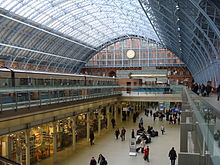
St. Pancras station - things you know and things you don't

WHO WAS ST. PANCRAS?

Well if it's a bit strange to name a station after a bear, it's even stranger to name one after an organ of the body. The obligatory bad joke over, who was he, and why is the Eurostar terminus named after him? Well, a Ten Word Wiki for him might read "Roman who converted to Christianity. Beheaded at age of 14."

OK, but what's that to do with the Euston Road? Well, it seems to be about relics. Centuries later, the Pope sent some of St. Pancras's relics to England in the hope that this would evangelise people. In return the British clergy named a number of churches after him. Including this one. Then people named the area after the church, and the rest is history.

CATHEDRALS OF STEAM

The London railway termini were an opportunity for the Victorian railway companies to show how great they were, so instead of little but picturesque stations such as were built for places such as Broadway

Photo courtesy Gloucestershire Warwickshire Railway

we ended up with a massive station at St. Pancras with a Victorian Gothic hotel in front of it, like this

Photos courtesy Wikipedia

The differences between this particular cathedral of steam and its next-door neighbour, King's Cross, are numerous. The one you see immediately is that St. Pancras is build of red brick, whereas the stock London brick is yellow (even if it does come from near Peterborough, but that's another story). Remembering that King's Cross (opened 1852) is built of yellow brick, and St. Pancras (opened 1868) is much grander, one cannot help but feel that this was a Victorian willy-waving exercise. This is nicely illustrated by the aerial photograph from Webb Aviation below:


THE DEMISE OF THE TANKARD

The next point to note about the differences between the two stations - and you can see it from the aerial photograph - is that the tracks of St. Pancras are considerably higher than those of King's Cross. As you enter St. Pancras station from the road, you climb steps; as you leave King's Cross you enter a tunnel. This 'loftiness' is only visible from the air, so no willy-waving here. The reason for the height differential is a blue line which is visible on the aerial photograph if you know where to look - the Regent's Canal. The line from King's Cross tunnels under the canal, but the line from St. Pancras crosses it by bridge. This forced St. Pancras station to be built on columns, and the planners were very careful. They created columns which were a certain distance apart. (No-one knows how these columns were made, but apparently the process involved ropes, tree trunks and horse urine!) This National Railway Museum photograph illustrates the columns during the building of the station:


The distance between the columns was equal to the width of three of these:

Photo courtesy Deposit Photos

Three beer barrels. For one of the directors of the Midland Railway was this Member of Parliament:

Photo courtesy Wikipedia

who also owned the brewery in the background of the picture of Burton on Trent:


Photo courtesy www.burton-on-trent.org.uk

Michael Thomas Bass Jnr. wanted to use the new railway to transport his beer from Burton to London. Burton Ales - pale ales and bitters - had traditionally been drunk from glasses (rather than the tankards which had prevailed elsewhere) due to the quality of the local water and the lightness of the drink: customers could see that the beer was clear in the glass. The beers prevalent in London at the time - stouts and porters - did not benefit from the clear glass, and were thus served in the traditional pewter tankard. As the Burton Ale became more popular in London, so glasses replaced pewter tankards. And thus the design of the station directly influenced behaviour in pubs.

BETJEMAN, AND THE SAVING OF THE STATION AND HOTEL

The 1960s had seen the rise of the motor car, and Beeching and Marples' rationalisation of the railways. Euston (including its Great Hall and iconic arch) was demolished in 1961-2 and replaced in 1968 by this homage to blandness:


A similar fate awaited St. Pancras in 1966. The hotel had become offices ("St. Pancras Chambers") in 1935, and by the 1960s had fallen into disrepair as illustrated here. As for the station, the issue with cathedrals of steam is - well - cathedrals and steam didn't go very well together. If you were wanting to take care of the stained glass windows of York Minster, your first priority wouldn't be to coat them in an ever thickening layer of dirt. Given the line out of the station, the Midland Main Line, was not electrified (and it still isn't), when diesel trains replaced steam trains the dirt continued to accumulate. This is well illustrated below in this photo from Urban75's blog  http://www.urban75.org/blog/st-pancras-railway-station-a-decade-ago-graffiti-smoke-and-wooden-panelling/:


Photo by Urban75

It seems somewhat ridiculous now with how many services use the two stations, but the idea was to route all St. Pancras services to and from King's Cross. Both the station and the hotel would have been demolished. Then John Betjeman - Poet Laureate, co-founder of the Victorian society, and enemy of everything bland - led a vociferous campaign to save the station and hotel. The words Betjeman used were "it would be a criminal folly to destroy a building whose name conjured up wondrous images of architecture and light in the mind of every Londoner". By 1967, the campaign had succeeded and both buildings were Grade I listed.

Listing buildings does not force them to be maintained - it merely means people cannot make changes without permission. It needed a grand scheme to renovate the station and the hotel.

HS1 AND THE OPENING OF EUROSTAR

When the Channel Tunnel was built between 1988 and 1994, it is not an exaggeration that France embraced the idea of High Speed Rail rather more than the UK. France built a high speed link from the tunnel to the Gare du Nord. The UK linked the tunnel into the legacy railway near Folkestone, then found a circuitous route across south London to terminate trains at Waterloo. Hardly ideal.

Then plans emerged to take the railway under south-east London to terminate near King's Cross. These plans were rejected because they would have caused environmental damage in south-east London, plus they offered no regeneration benefits. The revised plan which would take the line to St. Pancras would cross the Thames by bridge, and build stations at Stratford and at Ebbsfleet in the Thames Gateway. This was estimated in 2005 as being likely to create 50,000 jobs close to the two stations. Also, there existed the space to build a 'domestic' station at the back of the original station.

But how to do this? It's always difficult to build upon a well-known building without criticism either of pastiche, or of detracting from the original building. Alistair Lansley led the work, and the result was this:

Photo courtesy www.mimoa.eu

The building has character, but it is clearly from a different era to the old shed beside it. It's also very practical: diesel trains from Nottingham and Derby can terminate in the new shed, leaving the electric Eurostar trains to terminate in the old shed where they would not damage the restoration work. Some examples of this work follow:

Photo courtesy www.thevictorianweb.org

Here the ironwork has been painted with a colour close to the colour of the sky, to match the original paint used by the shed's architect, William Henry Barlow.


Photo courtesy National Rail

The undercroft, designed for beer barrels, now houses the Eurostar departures area.

Photo courtesy Wikipedia

Natural light floods into the undercroft via a hole made in the original train shed floor. Vandalism? Certainly not.

Photo courtesy BBC

The new station clock, reconstructed by the original clock makers, Dent of London. But what of the original clock? Well, it was sold to a collector in the US for £250,000, but it was dropped when it was being taken down, and smashed into pieces. A retired railway worker took the bits home to Nottinghamshire, and assembled the bits on the end of his barn. The result is below:
Phota courtesy www.worldarchitecturenews.com

A bit out of proportion with the barn, you might think? A bit like St. Pancras with Euston Road then. It doesn't mean it isn't good architecture.

THE REOPENING OF THE HOTEL

Whereas Eurostar services transferred from Waterloo to St. Pancras (overnight!) in 2007, it took until 2011 to reopen what became the St. Pancras Renaissance London Hotel. Pictures can describe the opulence far better than words, so here is a selection of photographs:

Photo courtesy Glenn Copus

Photo courtesy The Guardian

Photo courtesy The Guardian
 Photo courtesy The Guardian
There's nothing I can add to that, other than to hope that I stay there one day (it starts from about £750 per night for a room in the converted Chambers). Oh, just one little thing while I remember. Here's the bar and restaurant in the former booking office:
Photo courtesy http://tonesandjoy.wordpress.com

And how do they serve beer? In pewter tankards. Someone has read up on the history of the station.

Thursday, 27 December 2012

Solving the intractable problem of Camden Town

Anyone going to Camden Town by tube at a weekend to the markets will know that it can be crowded. Or even shut because it's so crowded. So from the 1990s onwards, London Underground came up with a plan to create more room at the station, with the latest plans being put forward in 2002. It would have replaced this landmark bank

(copyright The Local Data Company)

and this Leslie Green red-tiled tube station

(copyright Wikipedia)

with this new development.

(copyright www.alwaystouchout.com)


Furthermore it would have evicted Buck Street Market,


(copyright www.camdentownmarket.co.uk)

moved the Electric Ballroom music venue


(copyright Wikipedia)

and rebuilt the Trinity United Reformed Church.


(copyright spectrumlondon.org.uk)

Understandably, having upset those who value the current architecture, those who dislike modern architecture, market-goers and stall holders, music fans and church-goers, there was considerable local opposition. So much so that the scheme was rejected for three reasons (my précis):

  • detrimental to the local character (6 planning counts);
  • unsatisfactory for pedestrians (7 counts);
  •  too big (5 counts).
After rejection by a public inquiry in 2004 all went quiet, apart from LU stating in in 2007 they wanted to revisit the proposal. Then it went quiet again. Until now.

For all the benefits of a new station to visitors to Camden, most of the people who come to Camden on the train aren't heading for the markets. They are going to work.

(copyright TfL, edited by myself)

This is the Northern Line. It carries over 250,000 people per year, and everyone heading from the northern branches to work in the West End or the City passes directly under the Camden market area. This is the area of the line closest to Camden:


(copyright TfL, edited by myself)
Underground it looks like this:

(copyright husk.org)

This labyrinth of tunnels allows trains from both Edgware and High Barnet to access both the Charing Cross and Bank branches. Given that 20 trains per hour (tph) can run on each of the Edgware and High Barnet branches, the commuter in North London will have no more than six minutes to wait for a Charing Cross or a Bank train. And wait they do, because this gives them a rare commodity on the tube - a seat for all of their journey, be it to the City or the West End. So, under normal rush hour conditions, how many people change at Camden Town? Very few.

There is an upgrade to the signalling going on at the moment, which is why there are currently so many weekend closures. By 2014, the capacity will have increased to 24 tph on each branch. It's welcome, but it will mean that morning trains on the Bank branch go from being dangerously overcrowded to overcrowded.
Now here's the interesting part. The recent decisions regarding funding of a Northern Line extension to Battersea mean that trains will soon have two southbound destinations from Kennington. You don't have to be a rocket scientist to see that it will be trains from Charing Cross which will be heading for Battersea. Here's the current layout at Kennington:

(copyright skyscrapercity.com)

And here's the extension proposal:

(copyright TfL)

The reversing loop is a bit of a give away. Now there's absolutely no theoretical reason why trains from Charing Cross shouldn't carry on to Morden, as they do occasionally now - but it's a lot easier operationally to keep the lines separate, especially given that the line is so busy. But here's the rub - a recent article in Modern Railways states that London Underground are looking at the long-desired split of the [Northern] line into a Morden-High Barnet via Bank Line and a Battersea-Edgware via Charing Cross route...This would require the rebuilding of Camden Town station.

I can't source the information - but the dependency is fairly clear. The people changing at Camden Town on a southbound rush hour train from High Barnet can't be more than 10% from empirical evidence. And those people often stay on the platform to wait for the next train in the direction they are heading, because it's easier than the two minute cross-platform interchange with stairs - when, in any case, the next train is as likely as not to be behind you. 

With the new plans, all this would change. 50% of the people on the trains from High Barnet and Edgware would be changing from a train arriving every minute and a quarter across the narrow Camden tunnels - in the immortal words of Douglas Adams this is, of course, impossible. So do we need a revival of the Camden rebuild project? Well, no, not necessarily - but we should, at least in time, if we really care about Londoners.

It's essentially two separate schemes - one which benefits commuters, one which benefits weekend market-goers. That's not just my opinion. Look at this detail from the Inspector's Report from the public inquiry:

Notwithstanding the public benefits that the improved station would provide, the station works are effectively separate from the above ground redevelopment that would take place after completion of a crash deck slab over the station works.

I could look at the end of my nose and dismiss the weekend requirement - but it would be very short-sighted to do so. London thrives on the money Londoners spend in London outside the centre of town, and this must not play second fiddle to the business needs of the City, the West End and Docklands. We do need a two-phased approach here to secure funding - but we do need to understand the requirements for the second phase. To a certain extent it drives what we do in a first phase, as we will see. 

Let's look at the reasons for the failure of the station rebuild scheme. The markets - the primary people the scheme was designed to help - were one of the most vocal objectors. This can be interpreted as either poor stakeholder management, or a bad scheme. In my opinion, it's probably both, and a rethink is needed above ground.

First let's look at the conservation area to the north of the station:


(data from camden.gov.uk, modified by myself)

Conservation area: area in pink
Area subject to demolition with the original application: bounded by Camden High Street, Kentish Town Road and Buck Street

Key to numbered buildings
1: Buck Street Market
2: Camden Town Underground Station
3: HSBC Bank
4: Trinity United Reformed Church
5: Hawley Street Infants
6: Electric Ballroom
7: Inverness Street, of which more later

My immediate instinct given the planning history is to stay clear of the conservation area. Buildings 3 and 4 - the HSBC Bank and Trinity URC - were the subject of an attempt at spot listing during the campaign against the last plans. Furthermore, the exemption from spot listing ran out in 2009, so would be liable to reassessment should the plans be reintroduced. The inspector at the public inquiry came to the conclusion that at least some of the market area - building 1 - would be required underground permanently, and that was in a revised proposal which made the site very cramped. I feel that we effectively have stalemate, and we need to look outside the conservation area for a new site for the station building. 

The northern side of Buck Street looks to be a possibility, but Hawley Street Infants (sometimes described as Camden's Village School) should rule this out straight away. Edit 29/12/12: I am informed that Hawley Street Infants is to move to Hawley Wharf, a new development close to Camden Road Station. This redevelops an area devastated by a fire in 2008. A paragraph from the consultation document relating to the move of the school says The existing school site is surrounded by sites with planning permission for large developments, which are likely to cause disturbance and disruption to the school. Hawley would be overlooked and overshadowed once these developments are finished. 

I can't find details as to what these developments might be, but my instinct tells me to look elsewhere. With the lack of social housing on Hawley Wharf, common sense would suggest that social housing will be built on the school site once vacated in 2015. That takes us to the northern side of Inverness Street. 


(copyright homeaway.co.uk)

This is the view from Camden High Street. There's a market on the north side of the road, and it's already pedestrians only except for early mornings and evenings for loading. It's closer to the markets, and, provided we don't make the mistake of putting a new station on the corner, it solves the pedestrian and crime issues. Furthermore, apart from one hotel, we are talking about retail outlets and housing which could be replaced in a new - and modest - structure. And we can keep the old station entrance, and all of the emotive buildings can remain. 

The point about the corner is really important. Not only should the frontages on Camden High Street be able to be preserved, but one of the criticisms of the previous scheme - that it created opportunities for crime by virtue of having a blank frontage to Kentish Town Road - is immediately negated. Here is a possibility for a scheme:


(data from camden.gov.uk, modified by myself)

The area to the north of Early Mews is Arlington House, a shelter for homeless people, amongst other uses. This is equally emotive and shouldn't be touched. Although I haven't shown it clearly, the access to the rear of the properties of Camden High Street should be maintained. The market would need to move from its current position eastwards - but this link suggests that only 40% of the street is taken up by stalls, so this shouldn't be an issue.

Let's go back to the original scheme underground. I can't find the plans, but it was described by the inspector  of the public inquiry thus:

A bank of four escalators (two up and two down, but all reversible) would lead down to the northbound concourse level, via an elliptical atrium. From there further escalators would lead down to the southbound concourse and platforms. Three adits would link the concourse to each platform. The design of the station is constrained by the fact that the existing platform tunnels will not be repositioned or widened.

So, would this design cope with total separation of the Northern line branches? I estimated no more than 10% of a train from High Barnet changing at Camden Town in the morning peak. This would become 50% averaged over the two branches. Say for the sake of simplicity the split of people between the City and West End branches is even (it isn't, as more people are travelling to the City). Given that the separation (and other measures) will allow 32tph, we are left with the below frightening statistics:


And if anyone thinks I'm being alarmist, a person being taken ill on a train can easily cause a six minute delay. Can the southbound platforms cope with 1371 people on them? Of course not! And the evening peak is not going to be much better. A total rebuild is needed. But how without closing the line?

My objective is that TfL deliver something like this:


The two northbound and the two southbound branches share so called "Moscow platforms" (like those  designed by Charles Holden at Gants Hill.below). This allows cross platform interchange between the branches - without which we would see many disgruntled customers.


(copyright Wikipedia)

The platforms are either side of the pillars. The logic here is that it saves space, and there should always be plenty of room, as the only way the platforms could be really full is if there was a serious delay on one branch. If there were a serious delay on both branches, people would only be arriving from the station itself.

But how to build this design on to an operational railway? There seems to be little choice but to build below the existing station. Now - yet again - we come up with a major challenge. Under - and to both sides of -Camden High Street there lies a 370m long World War II deep-level tube shelter. It's not specifically listed, but there is little doubt that the inspector of the public inquiry considered it a major asset. Edit 29-12-12: My mistake here. The Inspector actually felt it to be beyond his scope to comment, in answer to a letter of objection from Barnet Transport Users Association, to which I was referring. My apologies - I elaborate on this in answer to a question from Long Branch Mike further down.

This challenge seems to me to be by no means insurmountable, but it does force the location of the platforms to the south of the current positions. This is any case necessary to an extent to create the cross platform interchanges, but it moves the platforms from their current position between the current station and Buck Street to south of Britannia Junction (the apex of Kentish Town Road and Camden High Street, south of the HSBC Bank).

A cynic might say this scheme is not deliverable without using the Buck Street Market as an interim work site, given it's fairly clear that there would be a requirement to have two sets of escalators down to the platforms with an intermediate open space. This would create a work site as below:


(data from camden.gov.uk, modified by myself)

If this extra space were necessary, would it be a show-stopper? Looking at the inspector's report:

Camden Market at Buck Street is in a highly visible location and it is hardly surprising that a high proportion of visitors at least look at the goods on the Camden High Street frontage. However, this does not mean that it is a crucial part of the markets as a whole, or that it is essential for their overall success.

Also we should consider this from Camden's planning brief on the site:

The Secretary of State agrees with the Inspector at 29.6.73 that due to the nature of their tenure, stall holders at Camden Market at Buck Street on the site are unlikely to be compensated, and that although some might be able to relocate, a number of businesses would be likely to fail with significant social and economic impacts on those who run or depend on them. The Secretary of State agrees there would be a significant impact on the traders and their dependents. However, he considers that the benefits of the new station in terms of transport, housing and sustainability would outweigh these negative impacts. The permanent acquisition of the land at Camden Market at Buck Street under a Compulsory Purchase Order is a matter for formal consideration by the Secretary of State for Transport.” (Paragraph 19)

This hardly makes the market site, at least in the interim, a show-stopper. It also has the benefit of removing one eye-sore - the Buck Street entrance to the deep-level tube shelter. An alternative access point would need to provided from an extended area underneath the market - but it was part of the original proposal to remove this entrance.

Could the platform widening part of the scheme be executed without the new station buildings on Inverness Street? It's not ideal, but I don't see why not. The initial access to the new platforms may not be all we would ask of it, but if our objective is to allow 32 tph in each direction on each branch without people having to traverse the station to change trains, we will have accomplished our objective.


So do we have a solution? I'm not a civil engineer, but I do know a bit about conflict resolution. I'll leave it to the wider community to comment.

**Many thanks to Taz for helpful suggestions on London Reconnections, which led to this article being written.

Two essential pieces of accompanying reading:

1. Public Inquiry - Inspector's Report
2. Camden Council - Camden Town Station Planning Brief


Edit 29/12/12 - Long Branch Mike asks: 


Ian you bring up an interesting point on your blog, to which I could not post a reply. Here it is:
I’ve thought about the use of the deep level tube shelter as a possibility for use in resolving this Camden Town branch changing problem. I’m glad you’ve brought it up, but you don’t seem to have developed the idea at all. Would that you could. It seems to be a great way of re-using a long idle asset, for the purpose it was designed for – hosting tube trains, to the benefit of the entire Northern Line(s).

Just to give those who don't know some background, there were eight deep tube shelters completed (two others were started), built during the Second World War for the Government, Four, including Camden Town, were handed over to be used by the public because of intensified bombing in 1944.

The description given by Wikipedia of the tunnels is "a pair of parallel tunnels 16 feet 6 inches (5.03 m) in diameter and 1,200 feet (370 m) long. Each tunnel is subdivided into two decks, and each shelter was designed to hold up to 8,000 people".  This sounds like a fantastic opportunity to run really long trains, until we remember "Each tunnel is of a diameter much larger than that usually used for running tunnels, but smaller than that used for the platform tunnels, hence they were constructed at the stations that would have been bypassed on the high-speed lines". Forgetting my incredulous look at the possibility of a high speed line bypassing Camden Town, we have something a little narrower than a Northern City Line tunnel. If we take out the bit in the middle for the length of a Northern Line train, do we have a big enough Moscow platform to cater for the number of people? Well, it's possible - I just don't know. The only information I could find was in the Inspector to the Public Inquiry's report: <i> The shelter consists of two long, deep tunnels that run either side of, and parallel to, Camden High Street, joined by cross-tunnels and with a main entrance in Stanmore Place south of Parkway.</i>  Also, the only information I could find regarding the relative depth of the deep tunnels to the tube lines was at Belsize Park from Subterranea Britannica: <i>About half way along the full length of the shelter tunnel is another cross passage with a wide stairway leading down to the lower level and up about 20 feet round a right-angle bend to a brick wall - this was the connection through to Belsize Park Station.</i> If this height differential is similar at Camden Town this is not impossible with gradients.

The bigger issue here is the sensitivity of the site. Although there is nothing in the planning brief precluding the use of the deep level shelter as railway tunnels - the Inspector to the Public Inquiry said merely <i>Access to the Deep Level Shelter Tunnels is not a matter for the Inquiry but they are let to a company and are used for storage.</i> Presumably that is why the deep tunnels themselves are not mentioned in the planning brief, but this, by no means, implies that they could be reused. I would suspect that there would be another long dispute if this was proposed, leading to a number of subterranean listings. The fact that the Euston Trust attempted to spot list the Buck Street passages to the tunnel shows the depth of feeling here.

One other point. Although the tunnels are double-decker, the floors between the decks are wooden in structure. I cannot perceive how it would be structurally sound to run all four platforms in the deep level tunnels. We are therefore left with what to do about the 'other' two platforms - leading to a proposal similar to mine, I would suspect. There's also the matter of cost - how far would you have to tunnel to rejoin all the branches?

In conclusion, lovely idea, but I don't think it - quite - works.

Saturday, 15 December 2012

Christmas in West London

Scene: Paddington Station
Date: Christmas Day 2012
Time: 10:30
Present: Paddington Bear, Isambard Kingdom Brunel

The railway being closed and Paddington Station being silent, Paddington Bear and Isambard Kingdom Brunel have left their respective plinths to admire their station. As they have done every Christmas Day in recent years, their paths cross. It is not hard for them to notice one another: apart from pigeons and scurrying rodents, they are the only creatures moving on the station.

If you were a fly on the wall (whom I didn't forget when talking about moving creatures: Freda the Fly is as still as the statues Brunel and Paddington were a few minutes ago) the first characteristic you might notice is the similarity between the old engineer and the bear from Darkest Peru. Both of small stature, both wearing a hat. both taking slow, short, serious steps as they make their way across The Lawn.

IKB: Happy Birthday, Mr Brown [and it is indeed Paddington's birthday. Or one of them, to be precise.]

PB: Merry Christmas, Mr Brunel. The noise on Eastbourne Terrace!

IKB: Well, we should enjoy our short-lived silence. That's the price of progress.

PB: But why couldn't they have built the Crossrail station under our station? Much less disruptive.

IKB: But cheaper to dig a big hole in the ground. And I have an interesting proposition to discuss with you Mr Brown.

PB: Please tell me.

IKB: Well, if I had had the tunnelling capabilities available today, I would have taken the Great Western Railway across the West End to Liverpool Street - a bit like they are doing today. So Paddington today would likely be an inner-suburban station a bit like Ealing Broadway. And, with the station not being a terminus, it wouldn't have the grand architecture. And you would probably not exist.

PB: Ah yes, but that would mean that King's Cross and St. Pancras wouldn't exist either, Maybe it was for the best that the technology came later? We would have lost some wonderful architecture.

IKB: But then the interchange stations would have been the places where we spent the money. So you could have been Farringdon Bear, for instance.

PB: Frequenting Smithfield Market rather than Portobello Market? No thank you. I'm very glad that the station is here.

IKB: Another point Mr Brown. If the railway as a whole had adopted my broad gauge, we wouldn't have the capacity issues we have now.

PB: But imagine the land costs Mr Brunel. The benefit to cost ratio goes down because we need more land to build the same railway. So we build less railways. Look at the M25.

IKB: I'd rather not.

PB: It's an obvious analogy. First we ask for a three lane motorway, then demand increases to fill the capacity. We then have a perfect business case for a four lane motorway. If we'd asked for a four lane motorway in the first place we would have been given nothing.

IKB: Economics delaying innovation, as ever. Which is why I'm so pleased to see Crossrail - even if it is 20 years late. Or 170 years late, depending on your point of view. But I really think we should have had four tracks built - that way the fast trains could have gone through the tunnels too, and many people could have travelled from the West Country to work in the West End, the City and Canary Wharf without changing.

PB: And we would have waited another 20 years or another 170 years for it to be built, Mr Brunel.

IKB: You are so damned practical Mr Brown. So what do you think of the new wires coming to Paddington?

PB: Well our station will be cleaner no doubt. But I do miss the old steam trains.

IKB: How sentimental, Mr Brown. You must barely remember them here. By the time you arrived from Darkest Peru, they had almost been replaced with diesel trains. But if I could have built electric trains, I would have done. It's not only the dirt: they are so much quieter, and they're easier to maintain. Steam trains are great for showing children history in action, but for running a railway give me electric trains any day.

PB: Well, at least we are having overhead wires. The trains from Victoria and Waterloo become stuck in the snow.

IKB: Even that seems to be changing with the announcement of overhead wires from Basingstoke to Southampton. But the wrong decision by Southern region to have third rail electric traction will take decades to reverse - unlike my correct decision to use broad gauge, which took a weekend to replace in 1892.

PB: I feel we have said all there is to say that is useful regarding the broad gauge, Mr Brunel. What do you think of the new station for the Hammersmith and City?

IKB: Well it looks nice - but it's still awfully crowded on the platforms. And it seems to be further to walk via the new taxi rank. Which is a great success.

PB: Yes, that was a good idea. It's a long way from platform 1, mind.

IKB: Maybe that's the idea - take your luggage on Crossrail as it's easier than a taxi. Great innovative thinking there.

PB: Or maybe it's the only place the taxi rank can go with the hole in the ground and the awful noise on Eastbourne Terrace.

IKB: Maybe you should suggest that your plinth is moved temporarily until the building work is finished?

PB: Thank you for that idea Mr Brunel, I shall suggest it to Mr Grober when I next see him.

The station clock moves on to 11:00.

PB: Well, it was lovely to see you again Mr Brunel, it's time for elevenses. Now I wonder where I can find marmalade sandwiches on our station on Christmas Day?